
The Basics of Taxes
“It is not true that Congress spends money like a drunken sailor. Drunken sailors spend their own money. Congress spends our money.” – Dr. Art Laffer
Here we will cover taxes, how they work and what happens to most of them. This will mostly be from an individual income and payroll tax perspective, although there are countless more taxes at federal, state and local levels, we will try to keep it simple and relevant to you.
What are my taxes spent on?
In most nations taxes are used to fund and run the country.
Paying for things such as
- Social Programs (Medicare, Social Security, Food Stamps, NHS, KELA, Shakai Hoken, etc.)
- Military Spending and Public Safety
- Education, Veterans and Disability Benefits
- Infrastructure Maintenance
- Foreign Aid and International Institutions
- Transportation
- Public Radio, Propaganda and Television (NPR, BBC, NHK, YLE, DW, RT, CCTV, etc.)
- Political Corruption (Bribery, Embezzlement, Political Lobbying at times, etc.)
- And much more

Social Programs
Military
Political Corruption
Taxes that mainly affect you
Income Taxes
Paid by you to the government. These are usually charged in a progressive system (The more you make, the more you pay)
Payroll Taxes
Paid by you and your employer to the government. These are usually charged at a flat rate (You pay the same, no matter how much more you make)
Most of us have jobs (hopefully), money form our paychecks are automatically deducted. The money can be taken for programs such as Social Security and Medicare if you live in the US. Once a year Americans need to file their taxes to confirm their income and see how much they overpaid or underpaid the government in taxes, often paying companies such as Intuit and H&R Block to file who then can use that money to lobby and prevent the government from filing for free for you. In many European nations, your taxes are filed for free automatically.
Okay, that's great and all, but what does this all mean for me?
Countries tax at different rates and levels but here we'll be focusing on American taxes.
The US uses a progressive system using brackets to tax you in pieces, but what's a bracket? Think of your income as a pizza, it's cut up and each slice is treated differently, some pizzas will be sliced more than others. We're going to round numbers for simplicity here.
|
Slice # |
Size of Slice |
Taxed at |
|---|---|---|
|
1 |
$0 - $12,000 |
10% |
|
2 |
$12,001 -$48,000 |
12% |
|
3 |
$48,001 - $103,000 |
22% |
|
4 |
$103,001 - $197,000 |
24% |
|
5 |
$197,001 - $250,000 |
32% |
|
6 |
$250,001 - $626,000 |
35% |
|
7 |
$626,001- and up |
37% |
Let's visualize this
Two people. different incomes, two pizzas
Alex
He made $50,000 last year
Mark
He made $1,000,000 last year.
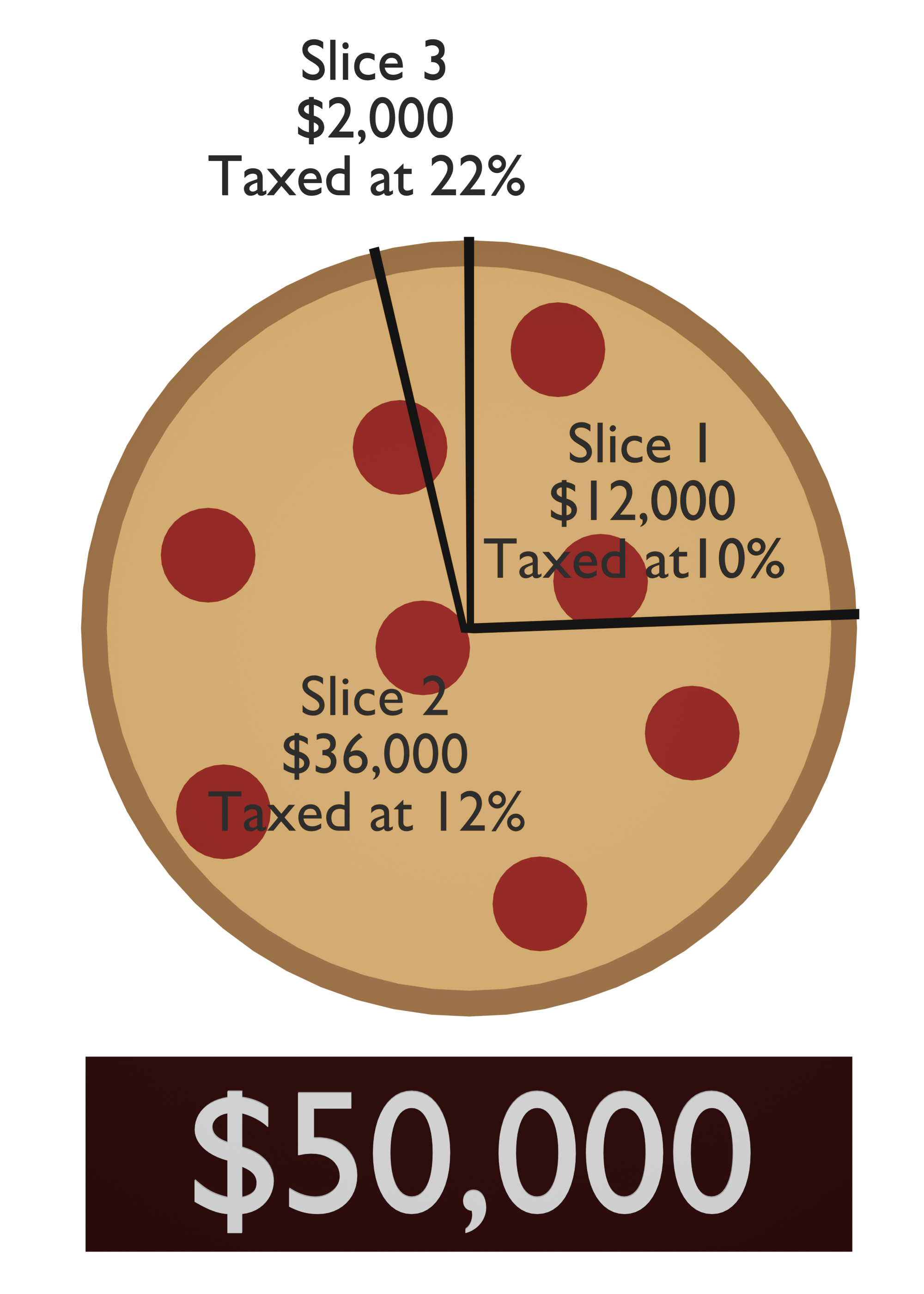
Alex's pizza is cut into 3 slices, taxed at 3 different rates.
In the end, Alex pays $5,960 in income taxes
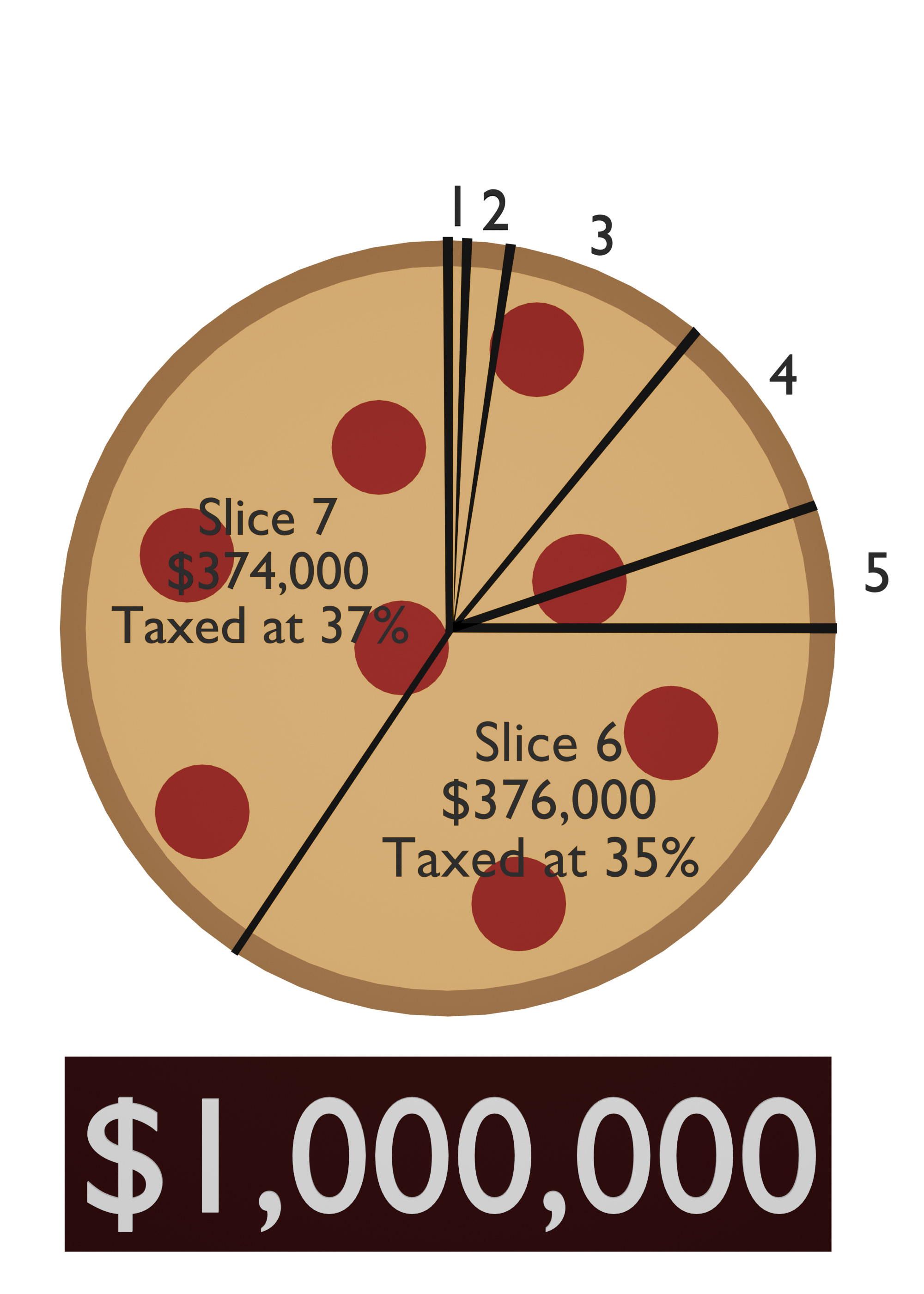
Mark's pizza is cut into 7 slices, taxed at 7 different rates.
In the end, Mark pays